We have sold our home and I'm in the process of tearing the railroad down.
I've got a retrospective to put together, but that might have to wait until I get more time.
This is mostly a warning that more content will be coming, sometime in the next few months.
Monday, April 18, 2016

Saturday, August 8, 2015
Picture Update
Posting prototype pictures to the gallery today. These as smallish JPGs that I've run through a watermark batch. If you'd like to purchase rights to a photo for research or modeling, please contact me for large (6000x4000 JPGs and Nikon RAW) files.
Rick
Rick
Friday, July 17, 2015
A teaser
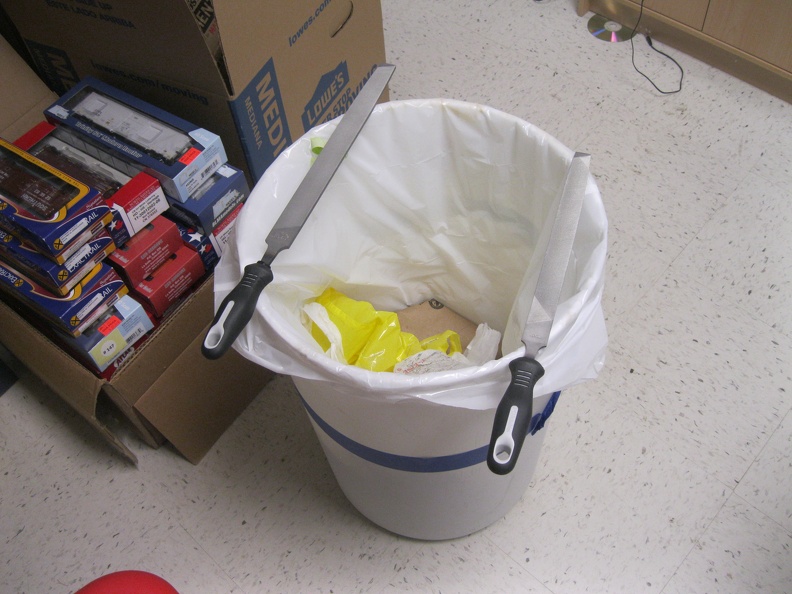
Hmm, wondering what in the world a trashbin has to do with model railroading?
Well, consider what we are seeing here - two files poised on the can.
Wonder what that could mean?
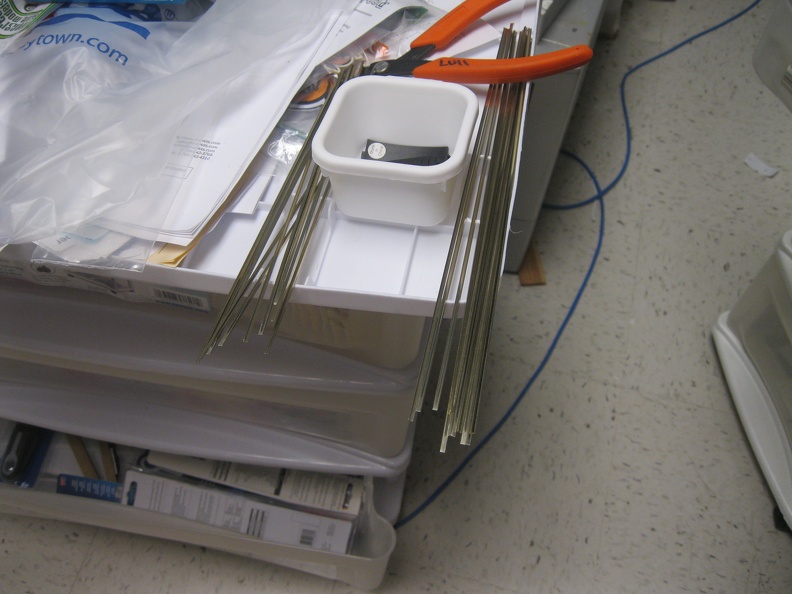 |
| Get the point? :) |
Thursday, July 16, 2015
June 2015 Op Session Recap
An operating session was held June 13 on the Richmond Terminal.
A full crew was present to put the railroad through its paces.
The session was the first with a larger Amtrak schedule, with trains better following the prototype (Amfleets used for everything except the Auto-Train; sleeper and diner on Silver service).
A couple of issues were found during the running of the session so changes will be in order for the next session, which should hopefully be August, but might have to get bumped to October.
I am going to document the waybills in a how-to as the crews continue to be confused by the process. (In their defense, my CC/WB system differs from everybody else in town and my operating being few and far between doesn't help)
Pictures follow:
A full crew was present to put the railroad through its paces.
The session was the first with a larger Amtrak schedule, with trains better following the prototype (Amfleets used for everything except the Auto-Train; sleeper and diner on Silver service).
A couple of issues were found during the running of the session so changes will be in order for the next session, which should hopefully be August, but might have to get bumped to October.
I am going to document the waybills in a how-to as the crews continue to be confused by the process. (In their defense, my CC/WB system differs from everybody else in town and my operating being few and far between doesn't help)
Pictures follow:
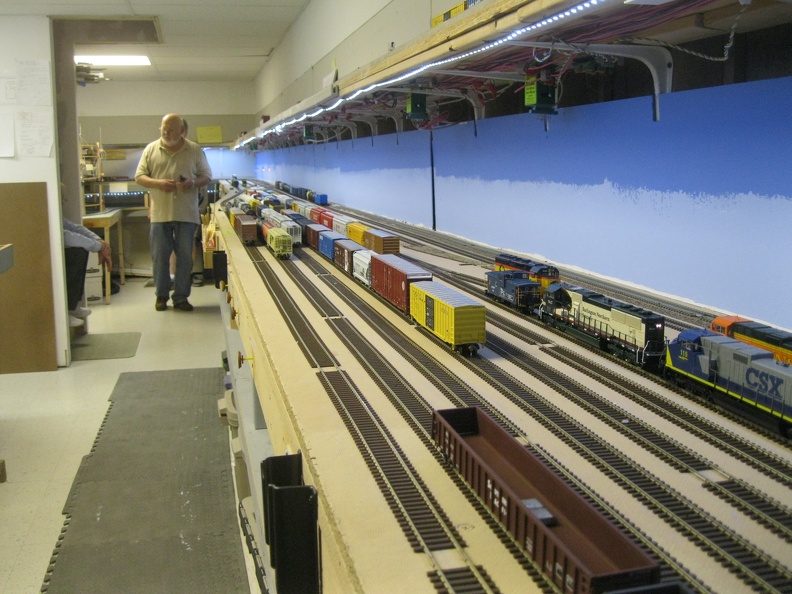 |
| Doug B working Acca; yard looks pretty empty at this stage in the session. |
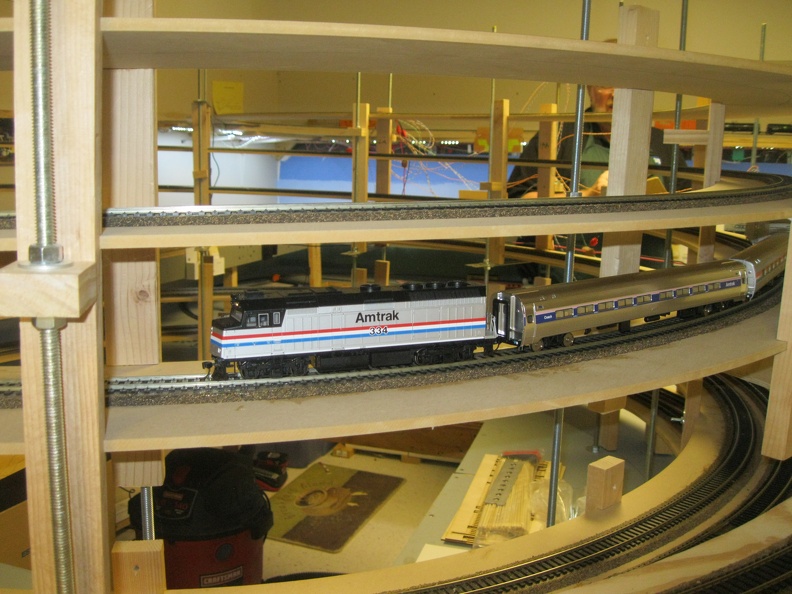 |
| The Carolinian is southbound after its station stop at Staples Mill. |
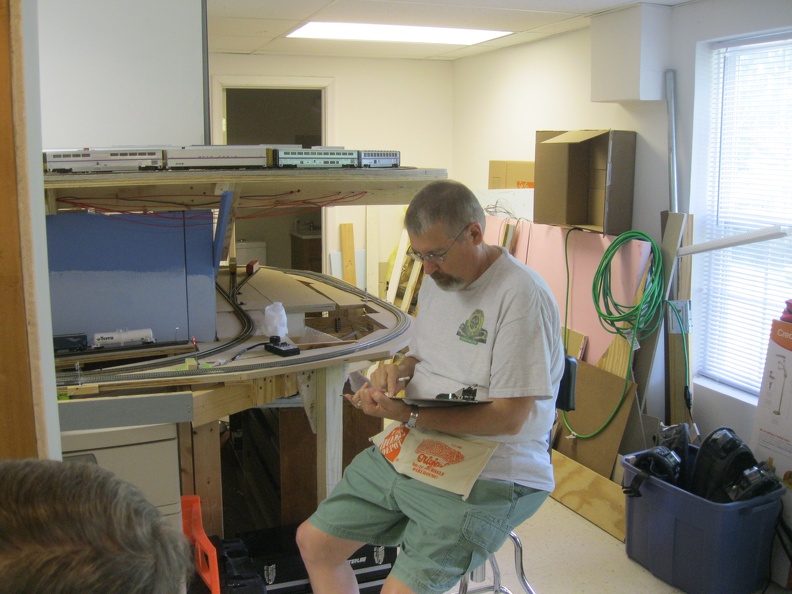 |
| Mike G making sure he is set for the next staging arrival and departure. |
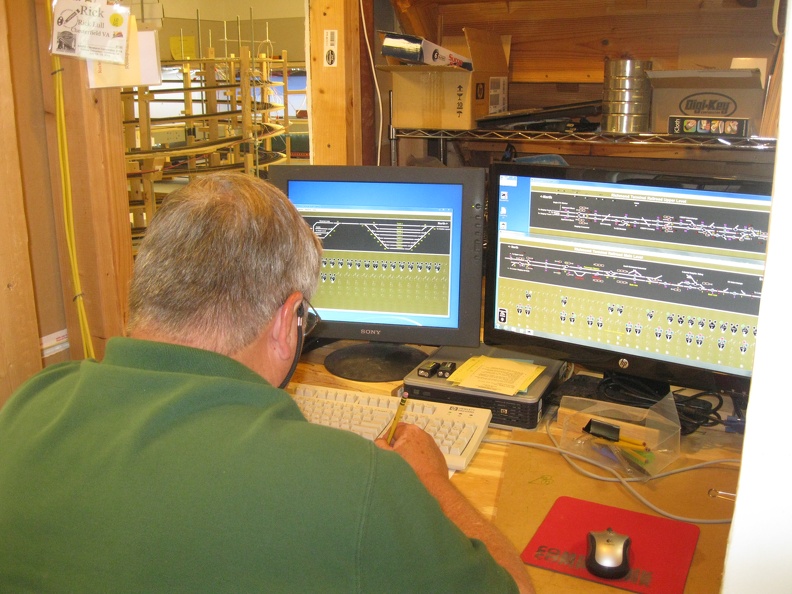 |
| Here we find our fearless dispatcher, Dick M, making a note as the session progresses. |
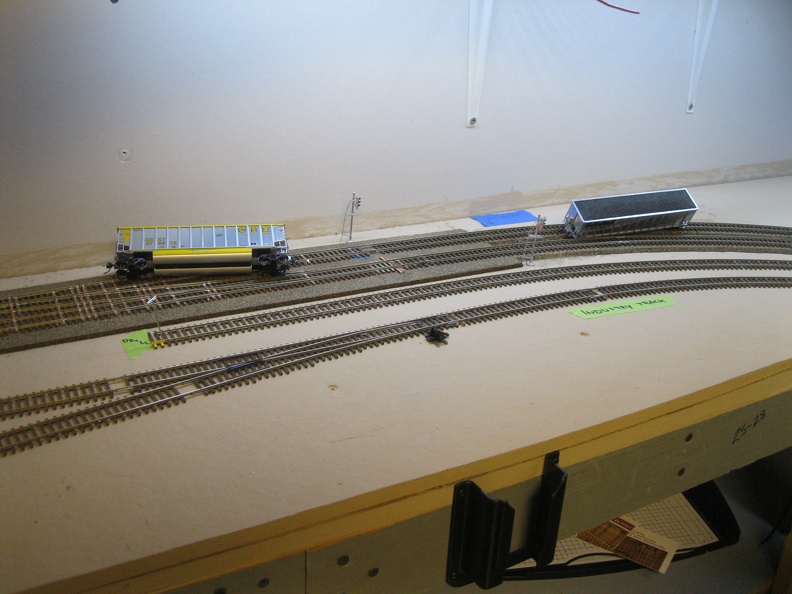 |
| Ah, the joys of experienced crews! |
Tuesday, May 12, 2015
Update
I will have some reviews about RockyOp coming fairly soon, as well as a post or three about where the layout is going.
Sorry about the lack of content here lately.
Sorry about the lack of content here lately.
Wednesday, April 22, 2015
Half a Sky
Started getting back and working on the layout after a pretty long layoff.
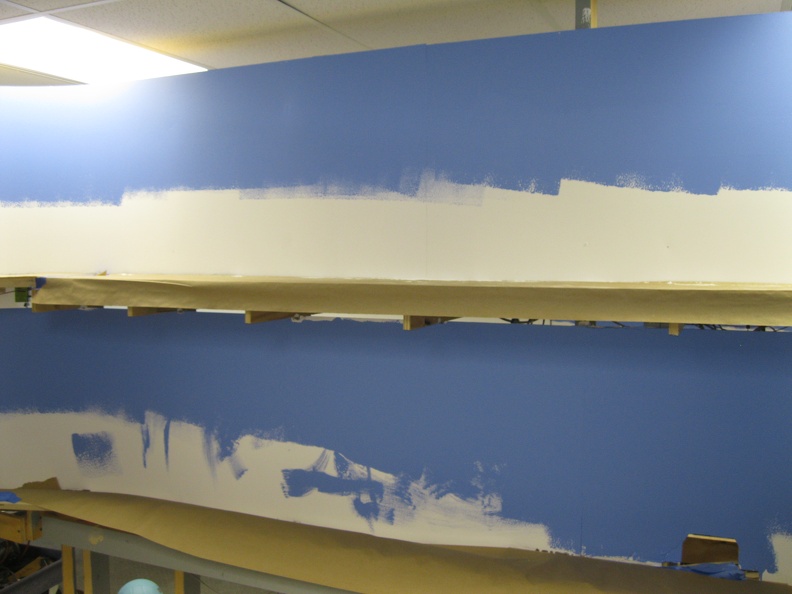
The next step is getting the backdrops painted a nice blue. My plan is to use two different shades of blue to hopefully give me the right slope of color across the sky.
So, here's the top, darker, color in a couple of shots.


The next step is getting the backdrops painted a nice blue. My plan is to use two different shades of blue to hopefully give me the right slope of color across the sky.
So, here's the top, darker, color in a couple of shots.
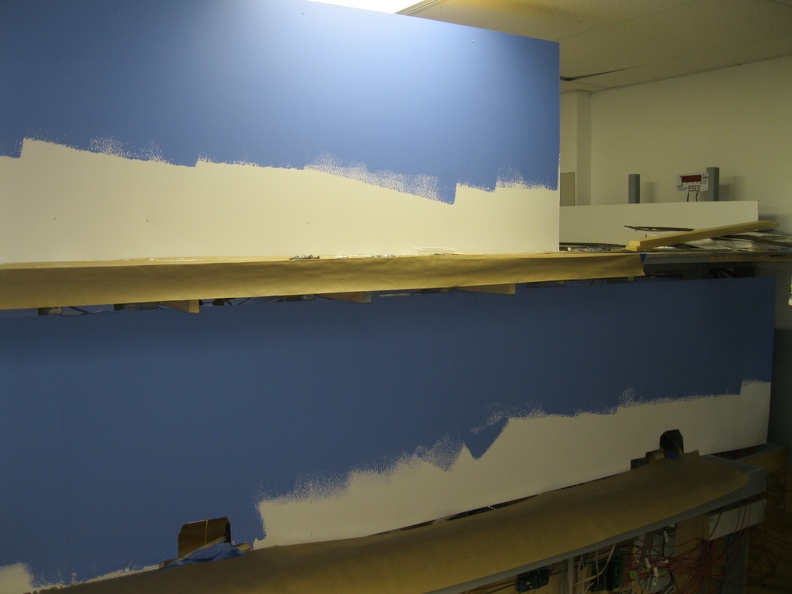
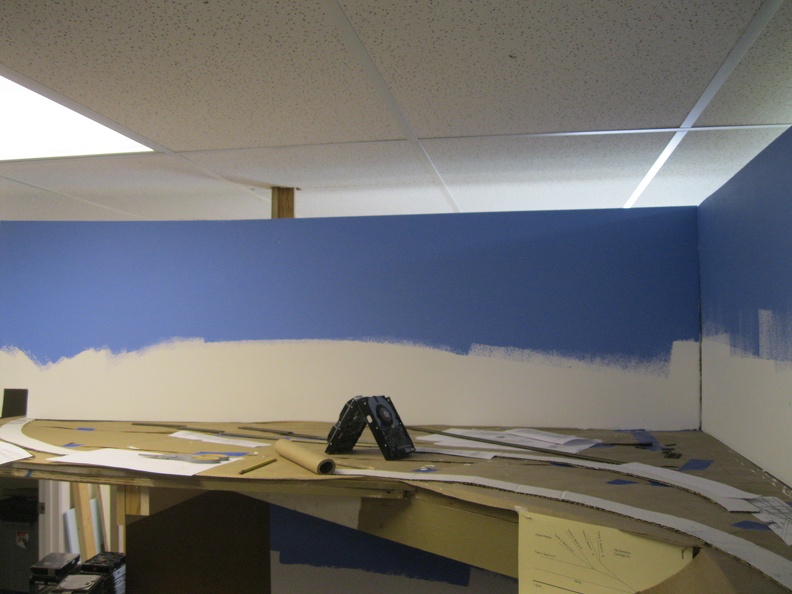 |
| Bear Island paper mill area in foreground |
Friday, March 13, 2015
Book Review - RF&P Passenger Service 1935 to 1975, William Griffin, Jr, TLC Publishing 2000
Richmond Fredericksburg and Potomac Railroad Passenger Service 1935 to 1975
Author William E. Griffin Jr
TLC Publishing 2000, Hardbound, 106 pages
TLC Publishing 2000, Hardbound, 106 pages
As promised on the full website, I will be reviewing books from my library that I would think is interesting to my readership or that have direct bearing on my modeling.
This book falls into the interesting rather that direct modeling, but I find the pre-Amtrak era of passenger service fascinating.
The book's cover is a wonderful shot of one of the RF&P's E8 A-B unit pairs southbound just north of Richmond, headed to Broad Street Station.
The book starts with a chapter on through service, as it
was the most common type on the line. Not a shocking fact, as the railroad was a major North-South bridge line. A 1956 passenger timetable is
reproduced, showing 16 (!) daily trains. One additional Monday through Saturday train is listed, so you would expect to see 18 trains a day had you been trackside. Now, I have a copy in my collection of the first Amtrak timetable for the RF&P's line, which has only 6 trains a day showing - 3 north and 3 southbound. A RF&P timetable from 1968 has 14 trains listed. A note is made on how SAL trains were numbered over the line, as the RF&P handled trains from both the ACL and Seaboard northbound. The book also has a short discussion here about the equipment that was contributed to the car pools that were
maintained to handle the service. Both diesel and steam powered trains are discussed with many
pictures sprinkled throughout the text. Related foreign road power is
also discussed and pictures are included. My only complaint here is that most of these are B&W shots, but I imagine the sources the author worked from are B&W so this is a shortcoming of the source material instead of the book itself. However, there is a dedicated color photo chapter near the end; I imagine that with color film only becoming available commercially in the mid 1930's, that the expense for somebody shooting color trackside would be significant.
Chapter 2 is local and connection service. Locals were not as numerous, as talked in the text due to the early building of highways in the area that the line ran, especially between Ashland and Richmond. An interesting point is that there were 15 flag stops between Ashland and Richmond in the 1920s, which would be totally unheard of today. Today, you could buy a ticket on Amtrak from Ashland (though not at the station, as it isn't manned by Amtrak nor is there an automated kiosk. Your option is to either buy a ticket at a different station or purchase via their website.) to either Main Street or Staples Mill, but folks would probably look at you askance, as the closeness of Interstate 95 and US1 and the ubiquity of the car seemingly precludes this. Interestingly, the railroad spun off a bus company to handle this business in the 1920's as well. A gas electric was purchased in 1928 to reduce the operating cost of local service on the north end. The book states that the last local trains to run were #10 and #29 in January 1957. On a slightly happier note, connecting service with the C&O and N&W are discussed with many pictures, as well as a timetable. The N&W service to Broad Street Station is what provided us with great pictures of the K2 class (a 4-8-2 with similar streamlining to the famous J class) leaving the station, and was also the inspiration for some wonderful railroad art as well.
We move on to the special trains of the railroad, dedicating a chapter to the subject, which details their success over the years. What is interesting about this situation is that special trains ran up until the advent of Amtrak, while local service didn't make it out of the 1950s. A trivia bit here is that for some years, the railroad was the largest ticket holder of the Washington Redskins, controlling a block of 600 seats. One wonders with the spring training site for the team now being in Richmond, what sort of deals would the RF&P have offered from the Washington area south, had the railroad still be independent of Jacksonville.
A chapter on Amtrak follows and the short lived, independent Auto-Train corporation is here is well. We have many color shots here, as Amtrak is a child of the 1970s and color film was cheap. (Well, certainly cheaper than in the 30s or 40s!)
Chapter 5 is all about the passenger stations, with the edifice of Broad Street given particular attention, with many aerial photographs. From there, the chapter covers stations spot by stop heading to the northern most station at Alexandria. Washington Union Station is mentioned, but isn't properly a RF&P only facility, as it was jointly shared with many railroads. Floor plans and exterior shots are sprinkled throughout, making this very helpful to the prototype modeler.
Chapter 6 covers passenger rolling stock with gratuitous pictures. Cars lists from 1960 and 1970 are included; each is a complete roster with type of car, the number and even name, if the car was named. The RF&P both used its own cars as well as those from other railroad depending on the train service, as well as contributing cars to the service pools. Some of these cars were built from similar plan used by other railroads that are frequently targets of the model manufacturers, giving the modeler easier starting points if they want to build a collection of rolling stock.
Chapter 7 is color photographs which closes out the book nicely. The first 3 pictures are all broad street station pieces, which I enjoy.
Chapter 2 is local and connection service. Locals were not as numerous, as talked in the text due to the early building of highways in the area that the line ran, especially between Ashland and Richmond. An interesting point is that there were 15 flag stops between Ashland and Richmond in the 1920s, which would be totally unheard of today. Today, you could buy a ticket on Amtrak from Ashland (though not at the station, as it isn't manned by Amtrak nor is there an automated kiosk. Your option is to either buy a ticket at a different station or purchase via their website.) to either Main Street or Staples Mill, but folks would probably look at you askance, as the closeness of Interstate 95 and US1 and the ubiquity of the car seemingly precludes this. Interestingly, the railroad spun off a bus company to handle this business in the 1920's as well. A gas electric was purchased in 1928 to reduce the operating cost of local service on the north end. The book states that the last local trains to run were #10 and #29 in January 1957. On a slightly happier note, connecting service with the C&O and N&W are discussed with many pictures, as well as a timetable. The N&W service to Broad Street Station is what provided us with great pictures of the K2 class (a 4-8-2 with similar streamlining to the famous J class) leaving the station, and was also the inspiration for some wonderful railroad art as well.
We move on to the special trains of the railroad, dedicating a chapter to the subject, which details their success over the years. What is interesting about this situation is that special trains ran up until the advent of Amtrak, while local service didn't make it out of the 1950s. A trivia bit here is that for some years, the railroad was the largest ticket holder of the Washington Redskins, controlling a block of 600 seats. One wonders with the spring training site for the team now being in Richmond, what sort of deals would the RF&P have offered from the Washington area south, had the railroad still be independent of Jacksonville.
A chapter on Amtrak follows and the short lived, independent Auto-Train corporation is here is well. We have many color shots here, as Amtrak is a child of the 1970s and color film was cheap. (Well, certainly cheaper than in the 30s or 40s!)
Chapter 5 is all about the passenger stations, with the edifice of Broad Street given particular attention, with many aerial photographs. From there, the chapter covers stations spot by stop heading to the northern most station at Alexandria. Washington Union Station is mentioned, but isn't properly a RF&P only facility, as it was jointly shared with many railroads. Floor plans and exterior shots are sprinkled throughout, making this very helpful to the prototype modeler.
Chapter 6 covers passenger rolling stock with gratuitous pictures. Cars lists from 1960 and 1970 are included; each is a complete roster with type of car, the number and even name, if the car was named. The RF&P both used its own cars as well as those from other railroad depending on the train service, as well as contributing cars to the service pools. Some of these cars were built from similar plan used by other railroads that are frequently targets of the model manufacturers, giving the modeler easier starting points if they want to build a collection of rolling stock.
Chapter 7 is color photographs which closes out the book nicely. The first 3 pictures are all broad street station pieces, which I enjoy.
A bibliography brings up the markers.
If you are interested in the RF&P, or just enjoying learning about pre-Amtrak service, I recommend the book to you.
Subscribe to:
Posts (Atom)

